Vendor Risk Red Flags: Early Warning Signs Before Compliance Fails
Imagine a late-night call: a contractor slipped on-site, their insurance had expired, and now your property management company is holding the bill. Incidents like this aren’t rare.
What’s less obvious is that situations like this rarely start with the incident itself.
The risk was already there. It showed up earlier in small, easy-to-miss moments during onboarding, documentation, or vendor approval.
Most portfolios don’t catch those signals in time.
These early warning signs are what actually determine whether compliance will fail later.
Want to know how to prevent vendor compliance risks before they turn into incidents? Download our Risk Assessment Worksheet to evaluate your vendor compliance process today.
What Are Vendor Risk Red Flags?
Vendor risk red flags are early indicators that a vendor may fail compliance, insurance, or contractual requirements later in the lifecycle. They appear during sourcing, onboarding, or renewal and signal elevated portfolio risk before formal violations occur.
Most vendor risk originates before compliance enforcement begins.
Catching these early signals is the first job of Compliance-Led Vendor Management. They are one part of a broader vendor compliance system for property management that governs how vendors are sourced, verified, and monitored across the lifecycle.
Why Vendor Risk Signals Are Missed Without Centralized Visibility
Most vendor risk signals are not missed because teams lack awareness. They are missed because visibility is fragmented across emails, spreadsheets, and disconnected systems.
When vendor data is scattered, early warning signs never aggregate into something actionable.
Most vendor risk is not invisible. It is simply not connected across the vendor lifecycle.
This is why fragmented tracking fails to surface risk signals early:
When compliance is handled manually, these red flags are easy to miss, and each one increases your liability exposure. Let’s look at the top risks every property management company should watch for.
Red Flag #1: Missing or Expired Insurance
Missing or Expired Insurance Puts PMCs at Risk
Vendors without valid insurance create serious compliance risks for property managers. Missing or expired policies expose PMCs to liability for accidents, injuries, and damages.
Property managers should never rely on vendors to report their own lapses. A governance system monitors coverage continuously and contacts the vendor's insurance agent directly, so a gap surfaces before the vendor reaches a property, not after an incident. When enforcement is tied to payment, a vendor whose coverage lapses is stopped automatically rather than flagged for someone to chase down.
This signal often appears during onboarding and predicts future insurance lapse exposure.
Red Flag #2: Incomplete or Inaccurate Vendor Information
Inaccurate Vendor Information Signals Risk
Incomplete or inaccurate vendor information is a red flag for fraud and operational disruption. Property managers cannot rely on vendors who fail to provide up-to-date business licenses, tax records, or proof of legitimacy.
Requiring verified vendor profiles and enforcing standardized documentation updates closes this gap. For PMCs, it creates a stronger compliance foundation and lowers the risk of approving fraudulent or unreliable vendors before they ever reach a property.
This typically appears during vendor setup and signals future verification and fraud risk.
Red Flag #3: Poor Safety Protocols
Poor Safety Protocols Endanger Properties and Tenants
Vendors without proper safety protocols put both workers and properties at risk. Accidents, OSHA violations, and injuries increase liability for property managers and harm tenant trust.
Safety requirements are not one-size-fits-all. They vary by trade and by owner. A governance system sets those requirements by vendor type, verifies certifications before a vendor is cleared to work, and re-checks them on a schedule, so an expired safety cert blocks the next job instead of surfacing after an incident.
This emerges during qualification and increases the likelihood of incident-related liability.
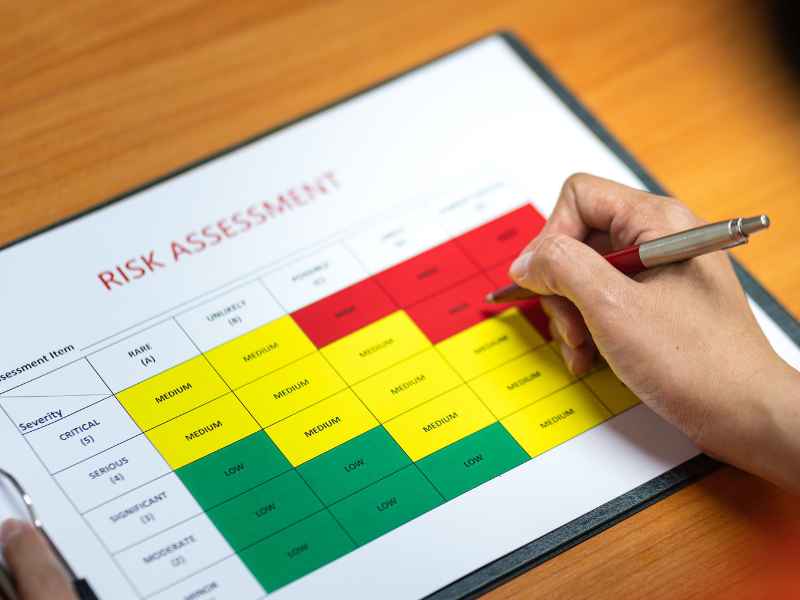
Use our Risk Assessment Worksheet to evaluate whether your current vendor network meets safety standards.
Red Flag #4: History of Contract Breaches
A Record of Breaches Reveals Unreliable Vendors
A vendor with repeated contract breaches, disputes, or missed deadlines is a compliance risk for property management companies. Even with competitive pricing, poor performance leads to costly disruptions.
This risk is contained when performance history travels with the vendor record across the portfolio, not in one manager's memory. A vendor flagged for repeated breaches at one property should not quietly win an award at another. Governance enforces that consistency; relationship-based selection does not.
This appears during vendor selection and predicts ongoing performance and compliance issues.
Red Flag #5: Financial Instability
Financial Instability Creates Serious Compliance Risks
Financially unstable vendors create compliance risks by cutting corners, abandoning projects, or hiding costs in unclear billing. Fraud warning signs include sudden price changes, inconsistent invoices, and hidden fees.
Financial vetting only protects you if it happens before approval and again at renewal, not once at signup. A governance system makes legitimacy and documentation a precondition of staying approved, so a vendor whose standing slips is caught at the next renewal or bid rather than mid-project.
This signal often surfaces during bidding or renewal and predicts cost instability and project disruption.

Red Flag #6: Weak Cybersecurity
Weak Cybersecurity Threatens Property Management Data
Vendors who fail to secure tenant or property data expose property managers to regulatory fines and reputational loss, and third-party exposure is climbing. SecurityScorecard's Global Third-Party Breach Report found that 35.5% of breaches in 2024 were linked to third-party access, up from the prior year.
Preventing this risk requires enforcing cybersecurity standards and tracking vendor compliance with data protection requirements as part of the overall compliance process.
Centralized vendor monitoring provides property managers with visibility into vendor risk factors, including whether vendors meet modern data protection standards.
This appears during vendor evaluation and signals exposure to data and regulatory risk.
Red Flag #7: Failure to Meet Regulatory Requirements
Non-Compliant Vendors Expose Liability
Vendors who lack licenses or certifications create immediate compliance risks for PMCs. Unlicensed work not only increases liability but may also invalidate insurance coverage.
Licensing is not a one-time check. A governance system verifies licenses and certifications at onboarding, monitors them continuously, and blocks a vendor from bid awards or dispatch the moment one lapses, so unlicensed work never reaches a property and never voids your coverage.
This appears during onboarding and signals immediate and ongoing compliance exposure.

Why Most Vendor Risk Is Caught Too Late
Most vendor risk is identified after compliance issues have already occurred.
By that point, the signals that predicted failure were already present during onboarding, documentation, or vendor approval but were never aggregated or acted on.
Centralized systems reduce human error by validating documents, tracking expirations, and flagging risks in real time. When compliance is centralized and enforced consistently, red flags are identified early or eliminated entirely. Prevention depends less on vigilance and more on systems designed to enforce accountability at scale.
What Strong Vendor Risk Control Looks Like in Practice
Identifying red flags is only effective if those signals are consistently captured and acted on. Strong portfolios do not rely on one-time checks. They enforce repeatable controls across the vendor lifecycle.
Managing vendor compliance risks requires a proactive, ongoing strategy. Property managers should:
- Conduct thorough vendor screening before engagement
- Establish clear compliance requirements and documentation standards
- Monitor compliance continuously, not just annually
- Ensure vendor requirements are enforced consistently across all properties
NetVendor governs vendors across the full lifecycle, not just at the certificate. Compliance is configured by owner, property, and vendor type, then enforced automatically: coverage is monitored continuously, vendors' insurance agents are contacted directly so documentation never stalls, and noncompliant vendors are stopped at the payment stage before risk reaches a property. Red flags get caught at sourcing and onboarding, not discovered in an audit months later. Berger Communities and Horizon Realty Advisors have both seen a 99% reduction in vendor-related risk exposure after centralizing compliance with NetVendor.

FAQs About Vendor Compliance Risks for Property Management Companies
How can property managers prevent vendor compliance risks?
Property managers mitigate vendor compliance risks by standardizing requirements, verifying insurance and credentials, and continuously monitoring compliance. Automation plays a critical role by tracking expirations, validating documents, and flagging issues before they create liability. Preventive compliance reduces lawsuits, audit issues, and operational disruptions while protecting tenants and staff.
What are the top vendor compliance risks in property management?
The most common vendor compliance risks in property management are missing or expired insurance, incomplete or inaccurate vendor information, poor safety protocols, a history of contract breaches, financial instability, weak cybersecurity, and failure to meet regulatory requirements. Each one signals elevated portfolio risk during sourcing, onboarding, or renewal, before a formal violation ever occurs.
How can property managers identify vendor red flags early?
Property managers identify vendor red flags early by screening vendors before engagement, verifying insurance and credentials at the source, and monitoring compliance continuously rather than annually. The earliest signals appear during sourcing and onboarding, so catching them depends on centralized visibility across the lifecycle, not periodic manual checks.
When do insurance-related vendor risks typically appear?
Insurance-related vendor risks typically appear during onboarding and renewal, when policies are submitted late, arrive incomplete, or are never verified against the owner's requirements. These early gaps are the most reliable predictors of future compliance failure, and they are easiest to catch when coverage is monitored continuously rather than checked once at setup.
Why is a vendor risk assessment worksheet useful for PMCs?
A vendor risk assessment worksheet gives property managers a structured way to evaluate current compliance practices, uncover gaps in insurance, credentialing, and documentation, and prioritize where risk is highest. NetVendor's Risk Assessment Worksheet turns an informal gut-check into a repeatable process you can apply consistently across every vendor and every property.
Take Control of Vendor Compliance Risks Today
Vendor risk does not begin at the moment of non-compliance.
It enters earlier through signals that are rarely tracked across sourcing, onboarding, and vendor approval.
When those signals are missed, compliance becomes reactive rather than preventive.
This is the difference between reactive compliance and a Compliance-Led Vendor Management approach.
Instead of responding to violations, vendor risk is identified and controlled at every stage of the vendor lifecycle.
Start by downloading the Risk Assessment Worksheet. It’s a practical way to identify compliance gaps in your vendor network and take the first step toward stronger vendor risk control.
Download the State of Vendor Management report
Download our report for a broader view of how compliance-driven vendor management is evolving across portfolios.

.png)
Vannessa Rhoades is Content Marketing Manager at NetVendor, where she leads content strategy on vendor management, compliance, and risk for property management operators. She brings 25+ years of experience translating complex, technical subjects into clear, decision-useful guidance for the people who run real estate portfolios.